

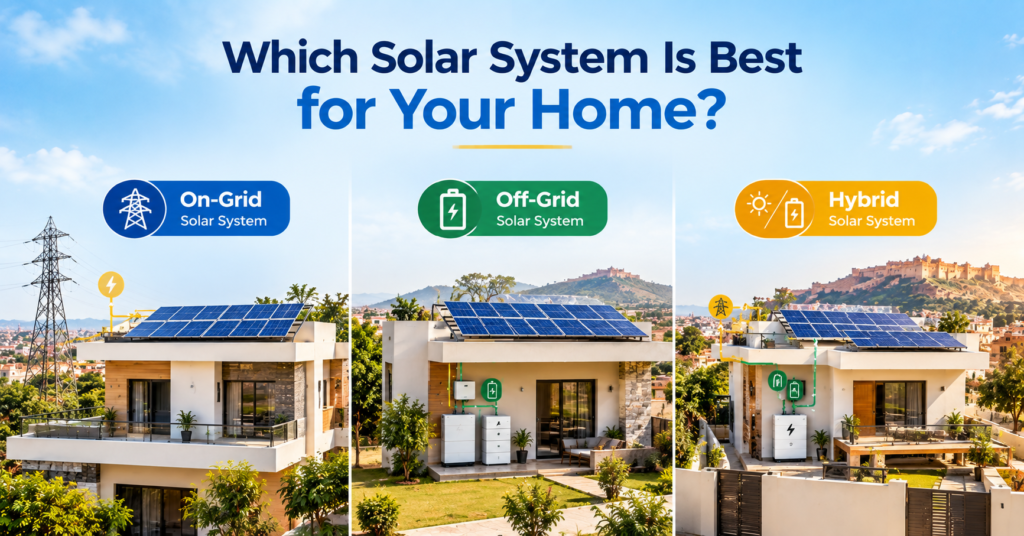
Choosing solar for your home is no longer just about installing a few panels on the roof. The type of solar system you select determines how your home uses solar energy, whether you need batteries, how you handle power cuts, and how much you may invest in the overall setup. For homeowners in Jaipur and other parts of Rajasthan, where rooftop solar can make practical sense, understanding the difference between on-grid, off-grid, and hybrid solar systems is an important first step. So, which solar system is best for your home? The answer depends on your electricity consumption, backup requirements, budget, grid connection, and how you want to use the energy your panels generate.
Let’s understand each option before making a decision.
What Are the Different Types of Solar Systems?
Residential solar systems generally fall into three categories:
- On-grid solar system: Connected to the electricity grid and generally designed to work without battery storage.
- Off-grid solar system: Works independently of the electricity grid and uses batteries to store solar energy.
- Hybrid solar system: Combines a grid connection with battery storage, offering both solar generation and backup capability.
All three systems use solar panels to generate electricity, but the way they manage and store that electricity is different.
What Is an On-Grid Solar System?
An On Grid Solar System is connected to the local electricity grid. Solar panels generate electricity during the day, and the home’s electrical loads can use that solar power. When solar generation is higher than the home’s immediate requirement, the excess electricity may be exported to the grid depending on the applicable electricity regulations and approved metering arrangement. When the home’s demand is higher than solar generation, electricity can be supplied from the grid.
Advantages of an On-Grid System
- No large battery bank is normally required.
- It can be a practical choice for homes with reliable grid electricity.
- The system can help reduce dependence on grid electricity during suitable solar-generation hours.
- Fewer battery-related maintenance considerations compared with battery-based systems.
What Is the Limitation?
A conventional grid-connected solar system generally does not provide backup during a grid outage because the system is designed to disconnect from the grid for safety. This is an important point that homeowners sometimes overlook. If your main objective is reducing electricity costs and you already have a reasonably reliable grid connection, an on-grid system can be a strong option.
What Is an Off-Grid Solar System?
An Off Grid Solar System is designed to operate independently of the electricity grid. Solar panels generate electricity, while batteries store excess energy for use when the panels are not producing enough power, such as at night or during periods of low sunlight. Because there is no dependence on the utility grid, the system needs to be appropriately sized for both daily electricity consumption and backup requirements.
Advantages of an Off-Grid System
- Provides independence from the electricity grid.
- Battery storage allows electricity to be used after sunset.
- Can be useful in locations with limited or unreliable grid connectivity.
- Offers greater control over stored solar energy.
What Should You Consider?
The batteries become a major part of the system. Their capacity, technology, operating conditions, maintenance requirements, and eventual replacement need to be considered when planning the system. An off-grid system also needs careful sizing. Simply matching the solar panels to average daily consumption may not be enough because the system must account for storage and periods of limited solar generation.
What Is a Hybrid Solar System?
A Hybrid Solar System combines solar panels, battery storage, and a grid connection. During the day, solar energy can power household appliances. Depending on the system configuration and energy demand, excess energy can be stored in the battery. The grid can provide electricity when solar generation and stored energy are insufficient. One of the biggest attractions of a hybrid setup is its ability to provide backup for selected loads during a grid outage, provided the system is designed and configured for backup operation.
Advantages of a Hybrid System
- Combines solar generation with battery storage.
- Can provide backup during power interruptions.
- Allows homeowners to store some solar energy for later use.
- Offers greater flexibility in managing household electricity.
What Is the Limitation?
A hybrid system generally involves more equipment and a higher upfront investment than a basic grid-connected system. Battery capacity also needs to be selected carefully based on the appliances you want to support during an outage.
On-Grid vs Off-Grid vs Hybrid: Key Differences
| Feature | On-Grid | Off-Grid | Hybrid |
|---|---|---|---|
| Grid connection | Yes | No | Yes |
| Battery | Usually not required | Required | Required |
| Backup during grid outage | Generally no | Yes | Yes, if configured |
| Grid dependence | Higher | Very low | Flexible |
| System complexity | Lower | Higher | Higher |
| Suitable for | Reliable-grid homes | Areas with limited grid access | Homes needing solar + backup |
There is no universally “best” system. The right choice depends on what you expect from your Home Solar System.
Which Solar System Is Best for Your Home?
If you’re wondering Which Solar System Is Best for Your Home, start with your actual electricity requirements rather than choosing a system based only on panel capacity.
Choose On-Grid If:
You have a stable electricity connection and your primary goal is to generate solar power and reduce your reliance on grid electricity. For example, a family living in Jaipur with regular grid availability and higher daytime electricity consumption may find an on-grid system suitable.
Choose Off-Grid If:
Your property has limited grid access or you want to operate independently of the utility grid. This can be relevant for certain remote properties, farms, or locations where grid availability is inconsistent.
Choose Hybrid If:
You want solar generation plus battery backup while retaining a grid connection. For a homeowner who experiences frequent power interruptions and wants essential appliances to continue operating, a hybrid system can offer greater flexibility.
Which System Is Better During Power Cuts?
This is where the difference becomes especially important. A standard on-grid system is generally not designed to keep supplying electricity when the grid goes down. This protects utility workers and the electrical network. An off-grid system can continue supplying power from its batteries because it operates independently.
A hybrid system can also provide backup when appropriately configured. However, the amount of backup available depends on battery capacity and which household loads are connected to the backup circuit. If backup is important to you, discuss your essential appliances—such as lights, fans, Wi-Fi equipment, refrigerators, or selected other loads—with your solar installer before finalizing the system.
Which System Offers Better Long-Term Savings?
The answer depends on your usage pattern and system design. An on-grid system can be attractive when the primary objective is reducing electricity purchased from the grid without adding battery storage. An off-grid system may require greater investment in batteries and system components, but it can provide energy independence where grid electricity is unavailable or unreliable.
A hybrid system provides additional flexibility, but the cost of battery storage needs to be considered alongside its backup benefits. Instead of asking only, Which system costs less?, homeowners should ask: Which system gives me the features I actually need?
That approach can help prevent paying for equipment that does not match your requirements.
Factors to Consider Before Choosing a Solar System
Before proceeding with Solar Panel Installation in Jaipur, consider these factors:
1. Monthly Electricity Consumption
Review your electricity bills and understand your typical consumption. A solar professional can use this information to recommend an appropriate system size.
2. Daytime vs Nighttime Usage
If most of your electricity consumption occurs during the day, an on-grid system may be particularly practical. If you need substantial energy after sunset, battery storage may become more relevant.
3. Power Cuts
Consider how often outages occur and which appliances you want to operate during an outage.
4. Roof Space
Your available roof area, orientation, shading, and structural suitability can influence the design of your solar system.
5. Budget
Don’t look only at the initial installation cost. Consider the complete system, including inverters, mounting equipment, batteries where applicable, installation, maintenance, and other associated requirements.
6. Future Electricity Needs
If you plan to add air conditioners, an electric vehicle, additional appliances, or other significant loads, discuss these plans before finalizing your system.
Why Professional Solar Panel Installation Matters
A solar system is a long-term investment, so installation quality matters. Professional planning should consider roof conditions, shading, panel layout, electrical safety, inverter selection, cable routing, system capacity, and the homeowner’s actual energy requirements. For homeowners looking for Home Solar Panel Installation in Jaipur, working with an experienced solar provider can make the process easier from understanding your consumption to selecting suitable equipment and planning the installation.
Why Choose MV Solar?
Choosing the right solar system starts with understanding your needs rather than simply selecting the largest system available. MV Solar works with homeowners and businesses to develop solar solutions based on practical electricity requirements, property conditions, and project objectives. Whether you’re considering an on-grid setup for your home, an off-grid solution for greater energy independence, or a hybrid system with battery backup, the right approach is to evaluate your requirements before making a decision. For homeowners searching for a Solar Company in Jaipur, a professional consultation can help you understand the available options and determine which configuration makes sense for your property.
Final Verdict: Which Solar System Is Best for Your Home?
So, which solar system is best for your home? If you have reliable grid electricity and mainly want to generate solar power, on-grid solar may be the simplest choice.
If you need to operate independently of the grid, off-grid solar may be more appropriate. If you want solar generation, grid connectivity, and battery backup in one setup, hybrid solar can provide greater flexibility. The best Solar System for Home is ultimately the one that matches your electricity consumption, backup needs, roof conditions, budget, and long-term plans. Before making the investment, speak with a qualified solar professional and get the system designed around your actual requirements.
FAQs
1. Which solar system is best for a home?
The best system depends on your electricity usage, grid reliability, backup requirements, roof conditions, and budget. On-grid, off-grid, and hybrid systems serve different purposes.
2. Is on-grid solar better than off-grid solar?
Neither is universally better. On-grid systems can suit homes with reliable grid electricity, while off-grid systems are designed for properties that need greater independence from the grid.
3. Is a hybrid solar system worth it for a home?
A hybrid system can be worthwhile if you want solar generation along with battery backup while maintaining a grid connection.
4. Which solar system works best during power cuts?
Off-grid systems provide independent power through batteries. Hybrid systems can also provide backup when designed for that purpose. A standard on-grid system generally shuts down during a grid outage.
5. Do on-grid solar systems need batteries?
Typically, no. A conventional on-grid system operates without battery storage, although battery storage can be incorporated into some system designs.
6. How do I choose the right solar system size for my home?
Start by reviewing your electricity consumption and usage pattern. Your roof area, shading, future energy requirements, and desired backup capacity should also be considered.