
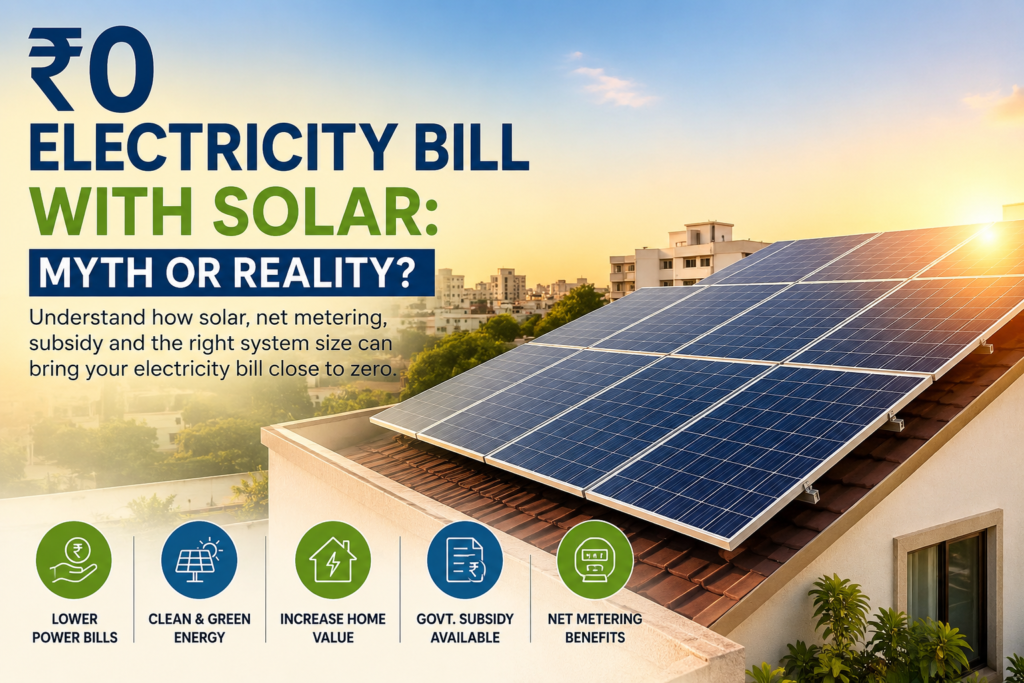
Seeing ₹0 Electricity Bill after installing solar sounds almost too good to be true. But can a solar system actually bring your monthly electricity bill down to zero? Yes, it can happen in some cases but it is not guaranteed for every home. Your actual savings depend on your electricity consumption, solar system size, rooftop conditions, generation, local electricity rules, and how much power your home uses during the day. With the right system design and net metering, solar can significantly reduce your dependence on grid electricity and, in suitable cases, bring the energy portion of your bill very close to zero.
Can Solar Really Give You a ₹0 Electricity Bill?
The short answer is: sometimes, but not automatically. A rooftop solar system generates electricity during daylight hours. Your home uses this solar power first. If your system produces more electricity than your home needs at that moment, the excess can be exported to the electricity grid under an applicable net-metering arrangement. When your solar generation is lower than your consumption, such as at night, you can draw electricity from the grid. At the end of the billing period, the imported and exported electricity are adjusted according to the applicable rules.
That is why the goal should not simply be “install solar and get a ₹0 bill.” Instead, the system should be correctly sized according to your actual electricity consumption.
How Does Net Metering Work?
Net metering is one of the main reasons rooftop solar can reduce electricity bills so substantially. For example, imagine a home consumes around 500 units of electricity in a month. If the rooftop solar system generates a similar amount of usable electricity over the billing period, a large portion of the grid consumption can be offset. Depending on the applicable tariff, metering arrangement, fixed charges and other billing components, the final bill could become very low.
Rajasthan has provisions for grid-connected rooftop solar and net-metering arrangements subject to applicable technical requirements and agreements with the DISCOM. So, a “₹0 Electricity Bill” should be understood as a possible outcome of well-matched solar generation and consumption, rather than a promise that every solar customer will receive a zero bill.
What Determines Your Solar Savings?
Several factors influence how much you save:
1. Your Monthly Electricity Consumption
A household using 200 units a month needs a different solar capacity from one consuming 600 or 800 units. The right system should be calculated using your electricity bills rather than simply choosing the biggest available system.
2. Rooftop Size and Sunlight
Shade from trees, nearby buildings, water tanks or other structures can reduce solar generation. A properly planned rooftop with good sunlight exposure generally allows the panels to perform better.
3. Solar System Size
An undersized system may not generate enough electricity to offset your consumption. An oversized system may also fail to provide the expected financial benefit depending on your consumption and applicable regulations.
4. Electricity Tariff and Billing Rules
Your final bill can include more than just electricity consumption. Fixed charges, taxes, duties and other applicable charges may remain even when solar offsets most of your energy consumption. This is why ₹0 Electricity Bill should never be advertised as a guaranteed result without checking the customer’s actual billing structure.
5. System Performance and Maintenance
Dust, shading, equipment condition and regular maintenance can affect generation. Keeping panels clean and ensuring that the inverter and other components are working properly can help maintain system performance.
Solar Panel Installation Cost in Jaipur
One of the first questions homeowners ask is: How much does solar panel installation cost in Jaipur? There is no single price for every home. The overall cost depends on factors such as:
- Required solar capacity
- Solar panel and inverter specifications
- Mounting structure
- Installation requirements
- Electrical work
- Metering requirements
- Roof conditions
- Applicable subsidy or financial assistance
For residential consumers, government subsidy under schemes such as PM Surya Ghar: Muft Bijli Yojana can reduce the upfront cost for eligible installations. The Ministry of New and Renewable Energy provides Central Financial Assistance for eligible residential rooftop solar installations through the applicable process. Because subsidy rules and eligibility can change, homeowners should check the current official guidelines before making a financial decision.
How Solar Subsidy Can Improve Your Savings
A solar subsidy does not mean that your electricity becomes free immediately. Instead, eligible financial assistance can reduce the initial investment required to install a residential rooftop solar system. This can improve the overall economics of solar by reducing the amount you need to invest upfront while your system continues generating electricity for years. For this reason, it is useful to calculate installation cost + applicable subsidy + expected generation + electricity savings, rather than looking at the subsidy alone.
Home Solar Panel Installation: What Should You Expect?
A professional home solar panel installation normally starts with understanding your electricity consumption and inspecting the available rooftop space. The process generally involves:
- Reviewing your recent electricity bills
- Assessing your rooftop and sunlight availability
- Selecting an appropriate system capacity
- Choosing suitable panels and inverter
- Installing the mounting structure and solar panels
- Completing electrical connections
- Handling applicable documentation and metering requirements
- Testing and commissioning the system
The objective should be a system that matches your home’s electricity requirements rather than simply installing the largest possible capacity.
What About Commercial Solar Panels?
The same principle applies to businesses, but the scale can be much larger. Shops, offices, schools, hotels, warehouses and factories often have significant daytime electricity consumption. Commercial solar panels can help businesses reduce their dependence on grid electricity and control long-term energy costs. For commercial customers, system size, sanctioned load, consumption pattern, tariff structure, rooftop area and applicable regulations should be evaluated before installation. A commercial solar project should therefore be based on a proper electricity-consumption and financial analysis rather than a generic “zero bill” claim.
A Simple Example: How Close Can You Get to ₹0?
Suppose a Jaipur household has a relatively consistent electricity requirement and installs a properly sized rooftop solar system. During sunny hours, the home consumes solar electricity directly. Excess generation can potentially be exported to the grid under the applicable metering arrangement. At night, electricity can be imported from the grid. If annual solar generation is well matched to the household’s annual electricity consumption, the net energy cost can become very low. However, the final bill may still contain applicable fixed or other charges.
So the realistic target is often very low electricity bills, with ₹0 being possible in suitable circumstances not guaranteed for everyone.
Is ₹0 Electricity Bill a Myth or Reality?
It is a reality for some solar users, but it is not a universal guarantee. Solar can dramatically reduce electricity expenses when:
- The system is correctly sized
- The rooftop receives sufficient sunlight
- The system performs efficiently
- Electricity consumption is properly assessed
- Applicable net-metering rules are followed
- The customer understands fixed and other billing charges
The smartest approach is to calculate your expected solar generation and savings before installation.
FAQs About ₹0 Electricity Bill With Solar
Can solar make my electricity bill completely zero?
It can happen in suitable cases, but it depends on your consumption, solar generation, metering arrangement and applicable charges. A zero bill should not be considered guaranteed.
How much solar do I need to reduce my electricity bill?
It depends on your monthly and annual electricity consumption, rooftop space, sunlight and system performance. Your recent electricity bills are the best starting point for estimating capacity.
Is solar subsidy available for homes in Jaipur?
Eligible residential consumers may receive financial assistance under applicable government rooftop solar schemes. Current eligibility and subsidy rules should be checked before installation.
Does net metering work with rooftop solar?
Grid-connected rooftop solar can use applicable net-metering arrangements subject to technical requirements, DISCOM procedures and prevailing regulations.
Can businesses install solar panels?
Yes. Businesses can install commercial solar systems to reduce grid electricity consumption and manage long-term energy expenses. The appropriate system depends on the business’s load and consumption profile.
Choose Solar Based on Savings, Not Just the ₹0 Promise
The idea of a ₹0 Electricity Bill is attractive, but the real value of solar is long-term energy savings. Instead of asking only, Will my bill become zero?, ask: How much electricity can my rooftop generate, how much can I save, and what system size makes financial sense for my property? That is where professional solar planning makes a difference.
MV Solar provides rooftop solar solutions for residential and business requirements, with services across Jaipur, Agra, Deeg, Dholpur and Bharatpur. Whether you are planning home solar panel installation or exploring commercial solar, the right system should be designed around your actual electricity usage and property requirements. Ready to find out how much you could save with solar? Contact MV Solar for a solar assessment and get a system recommendation based on your electricity consumption and rooftop requirements.